The Big Read: Enough is enough. Just what does it take to break mental health stigma at the workplace?
Advertising
Singapore
The Big Read: Enough is plenty. Just what does it have to break mental wellness stigma at the workplace?
Tackling the stigma surrounding mental illness and encouraging employees to speak up about their problems may be the biggest workplace challenge, based on interviews with workers, employers, man resource experts, general practitioners and psychologists.
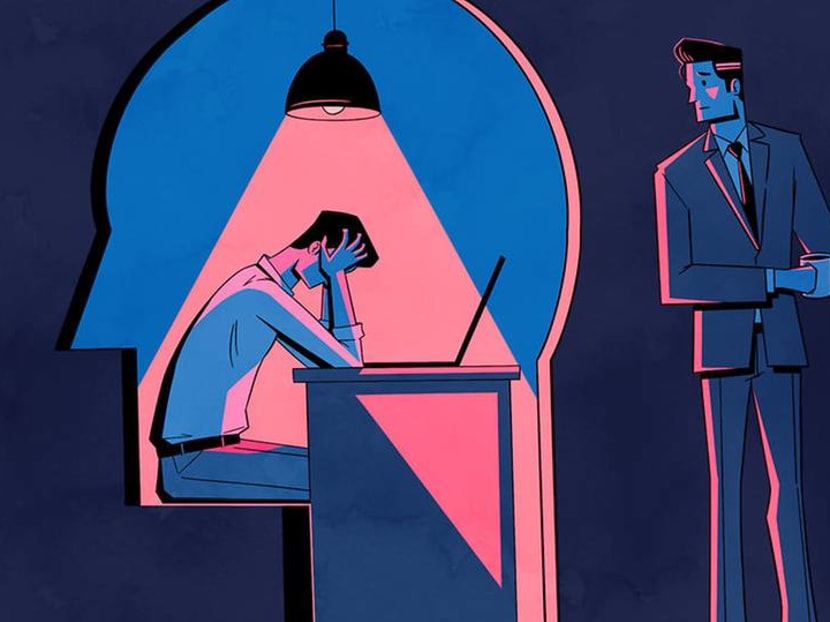
Having to support staff who take reached their breaking point may not be the biggest claiming when it comes to mental health issues at the workplace in Singapore. It is really tackling the stigma surrounding mental affliction and encouraging employees to speak upwards nearly their issues, based on TODAY'south interviews with workers, employers, homo resource experts, general practitioners and psychologists. (Illustration: Anam Musta'ein/TODAY)
30 Nov 2022 06:26AM (Updated: 30 Nov 2022 06:30AM)
SINGAPORE: For more ii years since she started working at a bank, Mavis (not her real name) has been keeping a secret from her bosses: She suffers from depression and anxiety.
While her company has hired counsellors, Mavis has never used their services, and seeks external counselling instead.
She has kept her mental health condition under wraps due to the "toxic" work civilisation, said the 25-year-erstwhile associate, and she fears that her chances of a promotion volition be stymied if her condition is out in the open up.
"Some have told me that (the company counsellors) will report dorsum to the bank, though my boss said that this doesn't happen - but you lot never know," she said.
"In my industry, you are expected to work very hard and expected to have endurance … Those who tin work a lot and handle a lot are seen equally improve."
A former trainee at a law business firm, who wanted to be known simply as Chloe, had a like experience.
The 26-year-quondam, who began working at the business firm early on last twelvemonth, developed anxiety attacks throughout her half-dozen-calendar month traineeship. Things worsened to the point where she broke down during several luncheon breaks, afterward feeling like she was manipulating her clients by withholding information.
"I felt like I had to lie to my client ... and I was under so much anxiety. During tiffin, I would go down to cry, because I felt like I merely couldn't cope."
Like Mavis, Chloe did not tell her bosses well-nigh her deteriorating mental health, but put on a poker face up when she returned to the role after each breakdown.
READ: Commentary: Will yous hire and retain persons with mental health weather?
"I have friends in the legal practice, and the communication given to me was that I could not speak to anybody most (my emotional bug). The concern was really stigma, so I had to become for individual counselling," said Chloe, who is no longer with the firm just is furthering her studies.
This is what some employees here accept to confront. Only what about the employers? What practice they have to say?
Those interviewed stressed that they are open to listening to their staff about whatever problems they may have, including mental health bug. However, they admit that a line has to exist drawn, specially when it comes to business-critical roles.
If the employees continue to autumn curt of expectations or are unable to work for long periods of fourth dimension due to their mental health conditions, the employers said they may have no selection simply to refer the workers to other roles within the company or burn them.
Still, having to support staff who take reached their breaking point may not be the biggest challenge when it comes to mental wellness bug at the workplace in Singapore.
It is actually tackling the stigma surrounding mental disease and encouraging employees to speak up nigh their issues, based on interviews with workers, employers, human being resources (HR) experts, full general practitioners (GPs) and psychologists.
While calls to ameliorate mental wellness awareness in the workplace are not new, the upshot has taken on an added urgency this yr with COVID-19 creating new stresses and pressures for anybody.
And with more people forced to work from home as the pandemic rages on, the boundaries between work and rest take been blurred, taking a farther price on the mental health of many employees.
READ: Commentary: We declare a goal of ending mental health stigma yet viciously mock the woman at Shunfu Market
READ: Commentary: Stress-related hair loss on the rising this COVID-19 outbreak
Simply even earlier the coronavirus struck, the mental health situation hither has been a growing business concern: The Singapore Mental Health Study conducted between 2022 and 2022 found that ane in seven people experienced a mental disorder in their lifetime, compared with one in eight people in 2010's Mental Health Report.
Just earlier this week, TODAY reported that the Ministry of Manpower (MOM) is investigating allegations made confronting a firm here where a former employee has committed suicide allegedly due to harsh working conditions.
READ: Commentary: Bollywood actor Sushant Singh's decease has gripped India and its politics
Against this properties, a tripartite advisory on mental well-being at workplaces was issued final calendar week by the MOM, Singapore National Employers Federation and National Trades Union Congress.
In introducing the advisory, Manpower Government minister Josephine Teo said "protecting workers' mental health has become even more than important" during the pandemic.
Amid its guidelines are:
- To engage mental wellness advocates to raise employees' sensation of mental well-existence and mental health conditions through talks and workshops.
- To provide access to counselling services such as through Employee Assistance Programmes.
- To review HR policies to ensure hiring practices, workplace practices and functioning management systems are non-discriminatory and merit-based in nature.
- To form informal support networks such as peer support programmes, parenting support groups, or a mentor/buddy organization.
While these guidelines are a pace in the correct management, more can be done in ensuring that these initiatives are not treated as a paper practice, and that cultural changes are enacted at the workplace, HR experts and mental health advocates said.
Ms Anthea Ong, founder of the WorkWell Leaders Workgroup, a customs of leaders from diverse companies and national agencies which champion workplace mental well-being, said that the guidelines are "solid building blocks" merely it will be up to the bosses to accept the lead in eradicating stigma at the workplace.
"If the leaders do not take hold of on and only leave it to the HR department to become and fulfil the requirements on the informational, so I don't think we have really made a paring," she said.
READ: Commentary: Burned out while working from abode? You should bank check your work-life boundaries
READ: 'A necessary investment': Why firms cull to comprehend employees for mental wellness services
"Until it is really embraced, acknowledged and acted upon by the leaders ... only then exercise nosotros start seeing these programmes, policies and practices making an impact on the ground," said Ms Ong, a former Nominated Fellow member of Parliament.
CHALLENGES FACED BY EMPLOYERS
While larger firms may have more resources to implement the tripartite advisory guidelines, this is not always the example for small and medium enterprises (SMEs), many of which are feeling the crunch from the current economic slowdown.
Mr Adam Esoof Piperdy, principal executive officer and founder of events company Unearthed Productions, said that SMEs like his are in a "very precarious position" during the pandemic and it may not be practical for them to tick every box in the informational.
"Such measures would (require) quite a high investment. I think what nosotros would rather do is to have more informal practices of checking in with each other," he added.

Even for larger firms with comprehensive mental health initiatives, the issue of employees non speaking up about their atmospheric condition remains a problem - one that has been exacerbated past remote working.
Ms Anuradha Purbey, people director at insurer Aviva Europe and Asia, said that a effect of remote working is that managers are non able to meet their employees on a frequent ground.
"Hence, information technology becomes harder to 'visibly' identify whatsoever mental wellness and other challenges that employees are facing," she said.
"So, we have to rely, primarily, on the online catch-ups and frequent surveys."
And like what Mavis and Chloe faced, Ms Anuradha best-selling that the stigma surrounding mental affliction is what prevents many firms from detecting mental health issues in the commencement identify, since employees are reluctant to reach out for assist.
"While mental health awareness has been gaining traction in Singapore, for many it is still considered taboo to acknowledge their struggles," she said.
READ: Commentary: In that location is rarely a right time to talk about your mental health when you lot're dating – but do it anyhow
"At Aviva, nosotros want to make talking about mental health as normal equally talking about concrete health and proceed to exercise what we can do to remove this stigma."
While in that location are firms which are willing to cut some slack for employees with mental health problems, they also said that at that place is a limit to how much employers can do.
Mr Piperdy, for example, said that he will try his best to get any colleagues struggling with mental health to seek professional aid or give them days off if they are unable to cope. However, since the event industry is a client-facing office, he cannot continually brand concessions at the take chances of letting his clients down.
"At the end of the day, the job telescopic doesn't change … if they're non able to manage the workload that comes in, which is something we actively do, then I think we volition help this person to transition to another job, maybe we volition look for opportunities for this person.
"We have successfully redesignated some of them, to observe suitable jobs in more stock-still, permanent (roles) such every bit working in a venue instead of working for an events company," Mr Piperdy added.
"Just we are actively trying to avoid that by having early on intervention, coaching and mentorships."
READ: MOH volition strengthen Singapore's long-term healthcare system even every bit information technology fights COVID-19: Gan Kim Yong
TAKING THE Get-go Pace: BOSSES Proverb 'It'S OK TO NOT BE OK'
In contempo years, some companies in Singapore have come up up with a slew of measures to promote mental wellness at the workplace, many of which are in line with the tripartite advisory'due south guidelines.
For instance, national media network Mediacorp introduced earlier this month an emotional and mental well-being support initiative that consists of emotional and mental wellness training and a one-on-one confidential counselling service, amongst other things.
Mediacorp Chief Man Resource Officer Yvonne Ee said: "As part of our corporate health initiative, we proceed to back up our people with resources they demand to adapt positively and perform well, during these unprecedented times."
She added: "Through (the initiative), nosotros wait to create an surroundings where staff can build stiff mental and emotional resilience, and feel secure every bit they continue to contribute to the organisation."
READ: Commentary: What'south backside burnout? Disruptive long hours and face time for piece of work performance
Biopharmaceutical business firm AstraZeneca Singapore said that amongst its mental health initiatives is an internal online platform for employees to discuss mental wellness issues and queries inside conversation groups. Information technology besides has in place the employee assistance programmes which provide confidential counselling.
President of AstraZeneca Singapore Vinod Narayanan said: "While we continue to build our open and inclusive culture at the workplace, we also recognise the impact COVID-nineteen has on mental well-existence of our employees and volition go along to build that infinite where it is safe for employees to speak openly near mental health issues."

In response to queries, business consultancy PwC Singapore said it provides several avenues to support mental health including an employee assist programme, workshops, support groups and online resource to drive awareness of the subject.
Online marketplace Carousell said information technology has a dedicated wellness programme where employees "come together as a team to focus on our well-being", at to the lowest degree once a month. It is too looking into establishing an employee assistance programme to offer support to employees struggling with personal and work-related issues.
While companies ramping up their mental wellness initiatives is a positive sign, Hour experts said that this has to be coupled with bosses who pb by example in creating a more than open company culture.
READ: Commentary: Putting in fifty hours while WFH, information technology's a struggle to draw the line between work and home
Earlier this calendar week, Bloomberg reported that Economic Evolution Board manager Chng Kai Fong had opened upwardly about his mental wellness struggle during the pandemic at a technology conference on Nov 22.
Mr Chng - who was formerly the principal private secretary to Prime Minister Lee Hsien Loong - said that family matters that occurred in April had affected his emotional and mental land, leading to feelings of "heat and anger" and depressive bouts.
According to Bloomberg, Mr Chng said he wanted to openly share his experience with others who might be facing mounting pressure to pb during times of fear and uncertainty.
"Nosotros can do a lot more as leaders to admit that (it's OK not to be OK) and to share a piddling fleck more about ourselves," Mr Chng said. "And that builds trust."
Otis Asia Pacific president Stephane de Montlivault, who is a member of the WorkWell Leaders Workgroup, said that existence more open virtually his struggles with mental health meant that employees of the elevator company were more willing to share their problems as well.
"I shared my personal situation as I happened to also have a number of difficulties (amid COVID-19). I lost a colleague and very close friend who died in a auto accident … and shortly afterward that my begetter-in-law had a eye attack and was in the ICU," he isaid. "I was facing a lot of stress, and had sleeping issues, anxieties."
READ: Commentary: Immobility during COVID-19 and its effects on our sleep, physical activity and well-being
When he shared these issues at a forum with his employees, many of them started opening up, and subsequently many were willing to go to their bosses directly with their problems, he said.
"(We) made information technology very open up and clear that information technology is not merely okay, simply normal and encouraged to talk near our difficulties and to piece of work on them as a team," said Mr de Montlivault.
"This actually caused us to have some actions in some cases when we found that people had difficulties when we were constrained by not being able to come up to the office."
READ: Commentary: I've been career oriented my whole life, until the COVID-19 pandemic took my appetite
Agreeing, Ms Ong said that bosses who are willing to reveal their vulnerable side send a clear betoken to employees that having mental health issues does non mean that they will not exist able to succeed at work.
"That's a very big part of stigma in the workplace, (which) stems a lot from concerns with career progression and advancement," she said. "When leaders are the ones sharing, and then it says that it does not affect your promotion options, your career progress, and your potential."
Veteran HR practitioner Carmen Wee said that the employer-employee relationship should be i that is centred on the well-being of the employee. "If employees are fearful in asking for help, in that location's something wrong with the culture or leadership approach," she said.
"If you lot work in a company where the company respects you, wants to look after their well-existence, which employee will not flourish and perform?
"At that place would non be such a fearfulness if employees "feel supported and don't feel like their psychological safety is threatened", she added.
Ms Wee noted that for cases where an employee'due south mental wellness status becomes too severe to continue working at a company, firing the employee should be a final resort.
Other alternatives such as no-pay exit, counselling and task coaching should starting time be considered.
"If at the end of the 24-hour interval, the person still can't cope and the job is still contributing to the stress, there needs to be a centre-to-heart talk, and if everything cannot exist worked out, they might have to part ways," she said.
Fifty-fifty when making such a decision, the company must also be sensitive given the pandemic state of affairs, where information technology may be difficult to find employment. Employers can introduce the afflicted workers to new jobs that may be more suitable, or link them up with job courses.
"Each person's circumstance is different, so the company needs to examine and come up with an individualised programme," Ms Wee said.
READ: Commentary: As therapy sessions motility online, more may finally seek needed help
READ: Commentary: Our arroyo to mental wellness needs to change. COVID-19 will force united states of america to
Physical AND MENTAL HEALTH SHOULD BE SEEN ON PAR
Although sensation of mental health here has grown, at that place remains a common misconception that concrete health takes precedence over it, when both in fact should be viewed on par, said psychologists and GPs whom TODAY spoke to.
Dr Geraldine Tan, manager and principal psychologist of The Therapy Room, said that whether information technology is a concrete or mental illness, patients can be "struck down" by it for a prolonged menstruum.
"When they take their diagnosis of anxiety and depression, they cannot become into the office, and someone else has to have over, so it is as bad as having surgery, or breaking your leg," she said.
Agreeing, GPs said that they would give medical certificates (MCs) regardless of whether it is a physical or mental ailment.
Dr Sunil Kumar Joseph, a GP who runs Tayka Medical Family Clinic in Jurong, reiterated: "Mental disease is treated the same every bit physical disease from a medical bespeak of view, so there is no effect."
The World Health System (WHO) defines wellness as "a state of complete physical, mental and social well-being and not merely the absence of disease or infirmity".
According to the American Psychological Association (APA), physical and mental health are interconnected and cannot exist viewed in isolation.
READ: Commentary: The nighttime underbelly of binge drinking among youths
"Stress tin can have a toll on our concrete health, while physical challenges can as well bring new stress into our lives," the APA said on its website.
Regardless of the literature, Dr Sunil said the main obstacle is the stigma that prevents patients from visiting him in the beginning place. And ane policy that propagates the stigma is company-paid insurance, he noted.
"Indirectly, (the company) is able to admission all your medical history considering you signed a waiver to your rights of confidentiality," he said. "Then very few people who are using corporate insurance are willing to disclose mental health weather condition, so that'due south one stumbling block."
He added that a lot of insurers do non pay for mental wellness treatment.
One guideline in the tripartite advisory says that companies with flexible employee benefits, such equally medical benefits, should consider extending the scope of coverage to include mental well-being programmes, mental health consultations and treatments.
Companies such as Aviva Singapore, consultancy house PwC Singapore and investment belongings company Jardine Bicycle & Carriage have health coverage plans that include mental wellness handling.
Otis' Mr de Montlivault said that as per the guidelines, his firm volition be looking to include mental health as part of its health coverage equally well. In the meantime, Otis employees can tap internal company self-funded insurance which has been expanded to include coverage for psychological support services.
If employees are hesitant to get MCs for their mental ailments, some companies accept a policy where a limited number of sick days tin be taken without having to produce an MC.Some employers besides provide medical leave based on trust, rather than having to always provide MCs.
Mr Jeffery Tan, master executive officer of charity organisation Jardines Mindset Singapore and group general counsel of Jardine Cycle & Carriage, said that if employees report that they accept mental health issues without an MC, it volition come downwardly to "managerial discretion and empowerment past the supervisors".
"Fifty-fifty for physical ailments, nosotros don't ever demand to be able to produce an MC before we can go off; we can encounter someone is struggling with an disquiet, they tin can take an afternoon off," said Mr Tan, who is besides part of the WorkWell Leaders Workgroup.
"This is coupled with an element of trust in a safe environs, every bit opposed to starting off by saying 'if I have this, are people going to game the system and be less than true?'," he added. "I call up those are all the wrong dynamics."
Like-minded, Ms Audrey Ng, global head of HR for mining business firm Anglo-American Marketing, said that trust is "primal to the relationship with our teams".
"Nosotros know that the overwhelming majority of them are highly defended and committed to achieving great results for the entire organisation, and so if we run into that someone needs a break, we endeavor to ensure that he or she feels empowered to take some fourth dimension off with line manager approval," said Ms Ng.
Still, some employees said taking medical leave as and when they demand to is not feasible, as they are on projection-based jobs.
READ: Commentary: Why do employers even so insist on an MC for staff who call in sick?
A junior art managing director at an advertising firm, who wanted to be known but as Isabel, said that the number of projects she had to do during the excursion breaker flow increased by about forty per cent every bit more than clients were looking to advertise online.
The longer working hours and higher workload resulted in the 24-year-old feeling stressed and anxious to the point where she would vomit regularly and lose her retentivity while at work.
She could not take a break as she had to see the clients' deadlines, and no one could take over her projects as they would not exist familiar with the clients' requests.
"In advertising, the mindset is ever clients first, and that's very detrimental on the employees," she said.
WHAT EMPLOYEES CAN Exercise THEMSELVES
Dr Douglas Kong, a mental health adept and performance coach, said that those who are stressed at work may not be able to identify the signs until information technology is too tardily.
"Those who are under stress, or have some issues in their life that they aren't treatment well … they can't run across information technology, and they exercise their best to cope and handle it," he said.
He has seen several cases of employees who would not admit to their stress and feet, only for their mental wellness atmospheric condition to worsen and affect their productivity.
"So people think that mental illness is terrible, that you must non have it … But the point is that if you tin deal with it earlier... it can permit the person to overcome information technology and get on with their lives and work," said Dr Kong.
Mr Adrian Choo, founder of career strategy consulting firm Career Agility International, said that employees must know "when to back off" when caught in a stressful situation.
"Employees themselves need to know when they are being stretched and are hitting the limit… (They) need to ask themselves what is more than important, your health or your career?" he said. "Because if you are burnt out, you are of no apply to your company anyway."
For Mavis, the bank employee who is hiding her mental health condition from her bosses, simply a meaning cultural shift in her company volition prompt her to open upwards about her struggles to her superiors.
"If I see a culture where you lot're talking openly about mental wellness, and it'south very clear that if I say something about it, not only my bosses simply my colleagues will non retrieve differently of me," she said. "(Instead) it will be something that can actually assistance me, with people being more caring and it is not something that volition be looked down on.
"She added: "But right at present, it is a far cry from that."
For more than news similar this, visit todayonline.com

Recent Searches
Trending Topics
Source: https://cnalifestyle.channelnewsasia.com/singapore/big-read-enough-enough-just-what-does-it-take-break-mental-health-stigma-workplace-295371
0 Response to "The Big Read: Enough is enough. Just what does it take to break mental health stigma at the workplace?"
Post a Comment