what do you use to go from a flexible duct to a room

A round galvanized steel duct connecting to a typical diffuser

Ducts are conduits or passages used in heating, ventilation, and air-conditioning (HVAC) to deliver and remove air. The needed airflows include, for instance, supply air, render air, and frazzle air.[1] Ducts commonly likewise deliver ventilation air as part of the supply air. As such, air ducts are i method of ensuring adequate indoor air quality too as thermal comfort.
A duct system is also called ductwork. Planning (laying out), sizing, optimizing, detailing, and finding the pressure losses through a duct system is called duct design.[2]
Materials [edit]
Ducts can be made out of the following materials:
Galvanized steel [edit]
Galvanized mild steel is the standard and most common material used in fabricating ductwork considering the zinc blanket of this metal prevents rusting and avoids cost of painting. For insulation purposes, metal ducts are typically lined with faced fiberglass blankets (duct liner) or wrapped externally with fiberglass blankets (duct wrap). When necessary, a double walled duct is used. This will usually have an inner perforated liner, then a 1–ii" (two.5-5 cm) layer of fiberglass insulation contained within an outer solid pipe.
Rectangular ductwork commonly is made to suit by specialized metal shops. For ease of treatment, it most often comes in 4' (120 cm) sections (or joints). Circular duct is made using a continuous spiral forming machine which tin can make round duct in almost any diameter when using the right forming die and to any length to accommodate, but the almost common stock sizes range evenly from 4" to 24" (x-60 cm) with half dozen"-12" (fifteen-30 cm) being most commonly used. Stock pipe is normally sold in x' (300 cm) joints. There are besides 5' (150 cm) joints of the non-spiral type pipe available, which is usually used in residential applications.
Aluminium (Al) [edit]
Aluminium ductwork is lightweight and quick to install. Also, custom or special shapes of ducts can be hands fabricated in the shop or on site.
The ductwork construction starts with the tracing of the duct outline onto the aluminium preinsulated panel. The parts are then typically cutting at 45°, aptitude if required to obtain the unlike fittings (i.e. elbows, tapers) and finally assembled with gum. Aluminium tape is applied to all seams where the external surface of the aluminium foil has been cut. A diverseness of flanges are available to suit diverse installation requirements. All internal joints are sealed with sealant.
Aluminum is also used to make round spiral duct, merely it is much less common than galvanized steel.
Polyurethane and phenolic insulation panels (pre-insulated air ducts) [edit]
Traditionally, air ductwork is fabricated of sheet metallic which was installed start and so lagged with insulation. Today, a sheet metal fabrication store would commonly fabricate the galvanized steel duct and insulate with duct wrap prior to installation. Nevertheless, ductwork manufactured from rigid insulation panels does not demand whatever farther insulation and tin can exist installed in a unmarried footstep. Both polyurethane and phenolic foam panels are manufactured with factory applied aluminium facings on both sides. The thickness of the aluminium foil can vary from 25 micrometres for indoor apply to 200 micrometers for external use or for higher mechanical characteristics. At that place are various types of rigid polyurethane foam panels bachelor, including water formulated panel for which the foaming process is obtained through the use of water and CO2 instead of Cfc, HCFC, HFC and HC gasses. About manufacturers of rigid polyurethane or phenolic foam panels utilize pentane as foaming amanuensis instead of the aforementioned gasses.
A rigid phenolic insulation ductwork system is listed as a grade 1[ description needed ] air duct to UL 181 Standard for Safety.
Fiberglass duct lath (preinsulated not-metallic ductwork) [edit]
Fiberglass duct board panels provide congenital-in thermal insulation and the interior surface absorbs [audio], helping to provide placidity operation of the HVAC system.
The duct board is formed past sliding a specially-designed knife along the lath using a straightedge as a guide. The knife automatically trims out a groove with 45° sides which does not quite penetrate the entire depth of the duct board, thus providing a thin department acting as a hinge. The duct lath can so exist folded along the groove to produce 90° folds, making the rectangular duct shape in the fabricator's desired size. The duct is then closed with outward-clinching staples and special aluminum or similar metallic-backed tape.
Flexible ducting [edit]
Flexible ducts (also known equally flex) are typically made of flexible plastic over a metal wire scroll to shape a tube. They have a variety of configurations. In the U.s., the insulation is usually glass wool, but other markets such as Australia, use both polyester fiber and glass wool for thermal insulation. A protective layer surrounds the insulation, and is normally composed of polyethylene or metalized PET. It is usually sold as boxes containing 25' (7.5 grand) of duct compressed into a 5' (1.v m) length. Information technology is available in diameters ranging from as small equally 4" (10 cm) to as big as 18" (45 cm), only the most unremarkably used are even sizes ranging from vi" to 12" (15 to thirty cm).
Flexible duct is very convenient for attaching supply air outlets to the rigid ductwork. It is commonly attached with long zip ties or metal band claps. However, the pressure level loss is higher than for most other types of ducts. As such, designers and installers endeavor to keep their installed lengths (runs) short, eastward.1000. less than 15 feet (5 m) or and so, and try to minimize turns. Kinks in flexible ducting must be avoided. Some flexible duct markets adopt to avoid using flexible duct on the return air portions of HVAC systems, yet flexible duct can tolerate moderate negative pressures. The UL181 test requires a negative force per unit area of 200 Pa.
Fabric ducting [edit]
This is really an air distribution device and is not intended as a conduit for conditioned air. The term cloth duct is therefore somewhat misleading; fabric air dispersion system would be the more definitive proper noun. However, every bit it often replaces hard ductwork, information technology is like shooting fish in a barrel to perceive it simply as a duct. Ordinarily made of polyester material, material ducts tin can provide a more even distribution and blending of the conditioned air in a given space than a conventional duct organisation. They may likewise be manufactured with vents or orifices.
Cloth ducts are available in diverse colors, with options for silk screening or other forms of ornament, or in porous (air-permeable) and non-porous material. The decision which cloth is appropriate (i.eastward. air-permeable or non) tin can be made by considering if the awarding would require an insulated metal duct. If and then, an air-permeable material is recommended because information technology will not commonly create condensation on its surface and can therefore be used where air is supplied below the dew point. Material that eliminates moisture may be healthier for the occupants. It can also be treated with an anti-microbial agent to inhibit bacterial growth. Porous material also tends to crave less maintenance as it repels dust and other airborne contaminants.
Fabric made of more than 50% recycled textile is also available, assuasive it to be certified equally light-green product. The material can also be fire retardant, which ways that the fabric can still burn down, only volition extinguish when the heat source is removed.
Fabric ducts are non rated for use in ceilings or curtained attic spaces. Notwithstanding, products for use in raised flooring applications are available. Cloth ducting usually weighs less than other conventional ducting and will therefore put less stress on the edifice's structure. The lower weight allows for easier installation.
Fabric ducts require a minimum of certain range of airflow and static pressure in order for information technology to work.
PVC depression-contour ducting [edit]
PVC low-profile ducting has been developed as a cost-effective culling to steel low-profile ducting. Low-contour ducting has been used extensively in apartment and hotel ventilation since 2005. The growth of low-profile ducting has grown significantly due to the reduction of available infinite in ceiling cavities in an effort to reduce cost. Since the Grenfell Tower fire in 2017 there has been a rise in the discovery of non-compliant building materials; many PVC low-profile ducting manufacturers have struggled to proceeds or maintain compliance, and some building projects accept had to resort back to using the more expensive steel option.
Waterproofing [edit]
The finish for external ductwork exposed to the weather tin can exist sheet steel coated with aluminium or an aluminium/zinc blend, a multilayer laminate, a fibre reinforced polymer or other waterproof coating.
Duct system components [edit]
Besides the ducts themselves, complete ducting systems comprise many other components.
Vibration isolators [edit]

An air handling unit with vibration isolator (three)
A duct system frequently begins at an air handler. The blowers in the air handler can create substantial vibration, and the large area of the duct arrangement would transmit this racket and vibration to the inhabitants of the building. To avoid this, vibration isolators (flexible sections) are normally inserted into the duct immediately before and after the air handler. The rubberized canvas-similar fabric of these sections allows the air handler to vibrate without transmitting much vibration to the attached ducts. The aforementioned flexible department can reduce the noise that can occur when the blower engages and positive air pressure is introduced to the ductwork.
Take-offs [edit]
Downstream of the air handler, the supply air trunk duct will commonly fork, providing air to many private air outlets such as diffusers, grilles, and registers. When the organisation is designed with a master duct branching into many subsidiary co-operative ducts, fittings chosen take-offs allow a small portion of the menstruum in the primary duct to be diverted into each branch duct. Take-offs may be fitted into circular or rectangular openings cut into the wall of the principal duct. The take-off commonly has many pocket-sized metallic tabs that are then aptitude to attach the have-off to the principal duct. Round versions are called spin-in fittings. Other take-off designs use a snap-in attachment method, sometimes coupled with an adhesive cream gasket for improved sealing. The outlet of the have-off then connects to the rectangular, oval, or circular branch duct.
Stack boots and heads [edit]
Ducts, peculiarly in homes, must often allow air to travel vertically within relatively thin walls. These vertical ducts are chosen stacks and are formed with either very wide and relatively thin rectangular sections or oval sections. At the bottom of the stack, a stack boot provides a transition from an ordinary large round or rectangular duct to the thin wall-mounted duct. At the top, a stack head can provide a transition back to ordinary ducting while a annals head allows the transition to a wall-mounted air register.
Volume control dampers [edit]
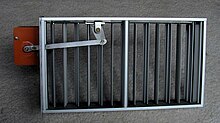
An opposed-blade, motor-operated zone damper, shown in the "open" position.
Ducting systems must oft provide a method of adjusting the volume of air flow to various parts of the system. Volume control dampers (VCDs; not to be confused with smoke/fire dampers) provide this part. Also the regulation provided at the registers or diffusers that spread air into private rooms, dampers tin can be fitted within the ducts themselves. These dampers may be manual or automatic. Zone dampers provide automatic control in simple systems while variable air volume (VAV) allows command in sophisticated systems.
Smoke and fire dampers [edit]
Fume and fire dampers are institute in ductwork where the duct passes through a firewall or firecurtain.
Smoke dampers are driven past a motor, referred to equally an actuator. A probe connected to the motor is installed in the run of the duct and detects smoke, either in the air which has been extracted from or is being supplied to a room, or elsewhere inside the run of the duct. One time smoke is detected, the actuator will automatically shut the smoke damper until it is manually re-opened.
Burn down dampers tin can be constitute in the aforementioned places as smoke dampers, depending on the application of the surface area after the firewall. Unlike smoke dampers, they are non triggered by any electric system (which is an advantage in case of an electrical failure where the smoke dampers would fail to close). Vertically mounted fire dampers are gravity operated, while horizontal fire dampers are jump powered. A fire damper's near important characteristic is a mechanical fusible link which is a piece of metallic that will cook or intermission at a specified temperature. This allows the damper to shut (either from gravity or spring power), finer sealing the duct, containing the burn down, and blocking the necessary air to burn.
Turning vanes [edit]


Turning vanes are installed inside of ductwork at changes of direction (e.m. at 90° turns) in guild to minimize turbulence and resistance to the air flow. The vanes guide the air so information technology tin can follow the change of direction more easily.
Plenums [edit]
Plenums are the fundamental distribution and drove units for an HVAC system. The return plenum carries the air from several big return grilles (vents) or bong mouths to a central air handler. The supply plenum directs air from the fundamental unit to the rooms which the organisation is designed to heat or cool. They must exist advisedly planned in ventilation pattern.[ why? ]
Terminal units [edit]
While unmarried-zone constant air volume systems typically do not have these, multi-zone systems often have last units in the branch ducts. Usually at that place is ane terminal unit of measurement per thermal zone. Some types of final units are VAV boxes (single or dual duct), fan-powered mixing boxes (in parallel or serial organisation), and induction final units. Terminal units may also include a heating or cooling coil.
Air terminals [edit]
Air terminals are the supply air outlets and return or exhaust air inlets. For supply, diffusers are near mutual, but grilles, and for very pocket-sized HVAC systems (such as in residences) registers are besides used widely. Return or exhaust grilles are used primarily for appearance reasons, but some also incorporate an air filter and are known as filter returns.[3]
Duct cleaning [edit]
The position of the U.South. Environmental Protection Agency (EPA) is that "If no ane in your household suffers from allergies or unexplained symptoms or illnesses and if, subsequently a visual inspection of the inside of the ducts, y'all come across no indication that your air ducts are contaminated with big deposits of dust or mold (no musty odor or visible mold growth), having your air ducts cleaned is probably unnecessary."[4]
A thorough duct cleaning done by a professional duct cleaner will remove grit, cobwebs, debris, pet pilus, rodent pilus and droppings, newspaper clips, calcium deposits, children's toys, and whatever else might collect within. Ideally, the interior surface will exist shiny and brilliant after cleaning. Insulated fiber glass duct liner and duct board can be cleaned with special non-metallic bristles. Fabric ducting can be done or vacuumed using typical household appliances.
Duct cleaning may exist personally justifiable for that very reason: occupants may not want to have their firm air circulated through a duct passage that is non as clean equally the remainder of the house. Yet, duct cleaning will not unremarkably change the quality of the animate air, nor will information technology significantly affect air flows or heating costs.
Signs and indicators [edit]
Cleaning of the duct system may be necessary if:
- Sweeping and dusting the furniture needs to exist done more than usual.
- After cleaning, there is even so left over visible grit floating around the house.
- After or during sleep, occupants experience headaches, nasal congestion, or other sinus problems.
- Rooms in the house have lilliputian or no air catamenia coming from the vents.
- Occupants are constantly getting sick or are experiencing more than allergies than usual.
- There is a musty or dried odor when turning on the furnace or air conditioner.
- Occupants are experiencing signs of sickness, east.g. fatigue, headache, sneezing, stuffy or running nose, irritability, nausea, dry or burning sensation in eyes, olfactory organ and throat.
Commercial inspection [edit]
In commercial settings, regular inspection of ductwork is recommended past several standards. Ane standard recommends inspecting supply ducts every ane–2 years, return ducts every 1–2 years, and air treatment units annually.[5] Some other recommends visual inspection of internally lined ducts annually[half dozen] Duct cleaning should be based on the results of those inspections.
Inspections are typically visual, looking for water impairment or biological growth.[v] [6] [seven] When visual inspection needs to be validated numerically, a vacuum exam (VT) or eolith thickness test (DTT) can be performed. A duct with less than 0.75 mg/100m2 is considered to be clean, per the NADCA standard.[7] A Hong Kong standard lists surface deposit limits of 1g/gtwo for supply and render ducts and 6g/mii for exhaust ducts, or a maximum deposit thickness of 60 µm in supply and return ducts, and 180 µm for frazzle ducts.[viii] In the UK, CIBSE standard TM26 recommends duct cleaning if measured bacterial content is more than than 29 colony forming units (CFU) per 10 cm2; contamination is classified as "low" below 10 CFU/cm2, "medium" at upwards to 20 CFU/cmii, and "loftier" when measured above 20 CFU/cm2.[9]
Duct sealing [edit]
Air pressure combined with air duct leakage can lead to a loss of free energy in a HVAC organization. Sealing leaks in air ducts reduces air leakage, optimizes free energy efficiency, and controls the entry of pollutants into the building. Before sealing ducts it is imperative to ensure the total external static pressure of the duct work, and if equipment will fall within the equipment manufacturer's specifications. If not, higher energy usage and reduced equipment operation may result.
Usually available duct tape should not exist used on air ducts (metal, fiberglass, or otherwise) that are intended for long-term apply. The adhesive on and so called duct tape dries and releases with fourth dimension. A more common type of duct sealant is a h2o-based paste that is brushed or sometimes sprayed on the seams when the duct is congenital. Building codes and UL standards call for special fire-resistant tapes, oft with foil backings and long lasting adhesives.
Automated engineering science exists that can seal a duct system in its entirety from the inside out using a patented process and specialized sealant. This method for duct sealing is frequently used in commercial construction and multi-unit residential construction. The cost associated with automated duct sealing oft makes information technology impractical for the average homeowner to implement in their own house.
Signs of leaks [edit]
Signs of leaky or poorly performing air ducts include:
- Utility bills in winter and summer months above average relative to rate fluctuation
- Spaces or rooms that are difficult to heat or cool
- Duct location in an attic, attached garage, leaky floor cavity, crawl infinite or unheated basement.[10]
See besides [edit]
- Duct (industrial exhaust)
- Darcy friction gene
- Fire damper
- HVAC
- Bus duct
- Pressurisation ductwork
- Annals (air and heating)
- Smoke exhaust ductwork
- Canvas Metal and Air Workout Contractors' National Clan
- Compatible Mechanical Code
References [edit]
- ^ The Fundamentals volume of the ASHRAE Handbook, ASHRAE, Inc., Atlanta, GA, Usa, 2005
- ^ HVAC Systems – Duct Design, tertiary Ed., SMACNA, 1990
- ^ Designer's Guide to Ceiling-Based Room Air Diffusion, Rock and Zhu, ASHRAE, Inc., Atlanta, GA, United states of america, 2002
- ^ "Should You Take the Air Ducts in Your Home Cleaned?", U.S. Environmental Protection Bureau, retrieved April 17, 2008
- ^ a b NADCA (2013). "ACR, The NADCA Standard for Assessment Cleaning Restoration of HVAC Systems" (PDF). National Air Duct Cleaners Clan. Archived from the original (PDF) on 11 February 2015. Retrieved 16 June 2014.
- ^ a b ANSI/ASHRAE/ACCA (2012). "Standard 180 Standard Practise for Inspection and Maintenance of Commercial Building HVAC Systems". American Society of Heating Ventilation and Ac Engineers. Retrieved 16 June 2014.
- ^ a b Willis, Steve. "Verifying System Cleanliness: A Guide for Commissioning Providers" (PDF). world wide web.commissioning.org. American Commissioning Group (ACG). Retrieved 16 June 2014.
- ^ AIIB/ACRA/BSOMES/HKBCxC (2004). "A Management Practice Guidance Note on Air Duct Cleaning for Hong Kong". Asian Institute of Intelligent Buildings.
- ^ Chartered Establish of Building Service Engineers (Oct 2000). "TM 26: Hygiene Maintenance of Part Ventilation Ductwork".
- ^ Ductwork sealing article at Energy Star
Further reading [edit]
- Air Diffusion Quango Flexible Duct Performance and Installation Standard, 4th Ed., 2003
External links [edit]
-
 Media related to Ductwork at Wikimedia Eatables
Source: https://en.wikipedia.org/wiki/Duct_(flow)
0 Response to "what do you use to go from a flexible duct to a room"
Post a Comment