Hanging Art That Looks Like One Thing From One Angle and and Another Thing From Another Angle
Anamorphosis is a distorted projection requiring the viewer to occupy a specific vantage point, use special devices, or both to view a recognizable prototype. It is used in painting, photography, sculpture and installation, toys, and movie special effects. The word is derived from the Greek prefix ana-, meaning "back" or "again", and the discussion morphe, meaning "shape" or "course". Extreme anamorphosis has been used past artists to disguise caricatures, erotic and scatological scenes, and other furtive images from a casual spectator, while revealing an undistorted image to the knowledgeable viewer.[1]
Types of projection [edit]

Instance of mirror anamorphosis
There are two main types of anamorphosis: perspective (oblique) and mirror (catoptric). More complex anamorphoses tin exist devised using distorted lenses, mirrors, or other optical transformations.
An oblique anamorphism forms an affine transformation of the subject.[ii] Early examples of perspectival anamorphosis date to the Renaissance of the fifteenth century and largely relate to religious themes.[3]
With mirror anamorphosis, a conical or cylindrical mirror is placed on the distorted drawing or painting to reveal an undistorted epitome. The deformed picture relies on laws regarding angles of incidence of reflection. The length of the apartment drawing's curves are reduced when viewed in a curved mirror, such that the distortions resolve into a recognizable picture. Unlike perspective anamorphosis, catoptric images can be viewed from many angles.[3] : 131 The technique was originally developed in China during the Ming Dynasty, and the outset European manual on mirror anamorphosis was published around 1630 past the mathematician Vaulezard.[3] : 147, 161
Aqueduct anamorphosis or tabula scalata has a unlike images on each side of a corrugated carrier. A directly frontal view shows an unclear mix of the images, while each paradigm can be viewed correctly from a certain angle.
History [edit]
Prehistory [edit]
The Stone Historic period cavern paintings at Lascaux may make use of anamorphic technique, because the oblique angles of the cave would otherwise result in distorted figures from a viewer'southward perspective.[ citation needed ]
The aboriginal historians Pliny and Tzetzes both record a sculpture competition between Alcamenes and Phidias to create an epitome of Minerva. Alcamenes' sculpture was beautiful, while Phidias' had grotesque proportions. Nevertheless in one case both had been mounted on pillars, the decelerated perspective made Phidias' Minerva cute and Alcamenes' ugly.[iii] : seven-8
Renaissance [edit]


Viewed from the right oblique angle, the diagonal in The Ambassadors transforms into an undistorted memento mori.
Artists' experimentation with eyes and perspective during the Renaissance advanced anamorphic technique, at a fourth dimension when science and religious thought were equally important to its growth in Europe.[3] : lxx Leonardo's Eye past Leonardo da Vinci, included in the Codex Atlanticus (1483-1518), is the earliest known example. He later completed several big-scale anamorphic commissions for the King of France. Giacomo Barozzi da Vignola credited Tommaso Laureti as the originator of a perspectival anamorphic technique in 1 of the primeval written descriptions in The Two Rules of Practical Perspective, compiled between 1530 and 1540 but not published until 1583. Many other descriptions and examples were created before 1583 without access to Vignola's work.[3] : 29-30,32-33
The Ambassadors (c. 1533) by Hans Holbein the Younger is known for the prominent grey diagonal slash across the lesser of the frame which, when viewed from an acute angle, resolves into the image of a human being skull. It has been hypothesized that the painting, regarded as a vanitas – a meditation on the transience of life including the skull equally a memento mori – was intended to be hung aslope stairs to startle viewers with the sudden appearance of a skull.[four] 4 centuries afterwards, psychoanalyst Jaques Lacan noted in 'Of the Gaze equally Objet Petit a' (1973) that the use of anamorphism, particularly in this painting, is one of the few methods for making viewers aware of their gaze.[5]
17th century [edit]
By the 17th century, a revival of fantastical anamorphic imagery occurred. Magical and religious connotations were largely abased, and the images were understood every bit a scientific curiosity.[iii] : 115 Two major works on perspective were published: Perspective (1612) by Salomon de Caus, and Curious Perspective (1638) past Jean-Francois Niceron. Each contained extensive scientific and practical information on anamorphic imagery. In Niceron's piece of work, three types of large-scale anamorphism are explained: 'optical' (looking horizontally); 'anoptric' (looking upwards); and 'catoptric' (looking down i.e. from a mezzanine). A conical perspective is also described.[3] : 26-28 Towards the end of the century, Charles Ozanam'southward Mathematical Recreations widely popularized the techniques for the creation of anamorphic images.[3] : 117
Between 1669 and 1685, both perspective and mirror anamorphosis were introduced in People's republic of china past the Jesuits to the Emperor K'ang-hi and monks at the Peking Mission.[iii] : 157 However, Chinese production of anamorphic images were already occurring on a big scale during the late Ming Dynasty. The images were mostly created freehand, dissimilar the grid organization used in the west. As Chinese anamorphoses primarily focused on erotic themes, Jesuit influence is unlikely.[3] : 160-161 It is considered probable that Chinese catoptric techniques, which are technically unrelated to geometric anamorphosis, influenced European mirror anamorphosis, and not the other way around.[3] : 164-165

Baroque trompe-l'œil murals often used anamorphism to combine actual architectural elements with illusory painted elements to create a seamless issue when viewed from a specific location. The dome and vault of the Church of St. Ignazio in Rome, painted by Andrea Pozzo, represented the meridian of illusion. Due to neighboring monks complaining well-nigh blocked calorie-free, Pozzo was deputed to pigment the ceiling to wait like the inside of a dome, instead of building a real dome. Equally the ceiling is flat, there is merely one spot where the illusion is perfect and a dome looks undistorted.[ citation needed ]
Anamorphosis could exist used to conceal images for privacy or personal safety, and many secret portraits were created of deposed royalty. A well-known anamorphic portrait of the English King Edward 6 was completed in 1546, only visible when viewed through a hole in the frame. Information technology was later hung at Whitehall Palace, and may accept influenced Shakespeare during the writing of Richard II.[3] : 16-18 Many anamorphic portraits of King Charles I were created and shared following his 1649 execution.[3] : 28 A surreptitious mirror anamorphosis portrait of Bonnie Prince Charlie, held at the West Highland Museum, can simply be recognized when a polished cylinder is placed in the correct position. To possess such an paradigm would have been seen every bit treason in the aftermath of the 1746 Battle of Culloden.[6]
The memento mori theme continued into this period, such as in an Anamorphic Painting of Adam and Eve, on display at the Wadsworth Atheneum in Hartford, Connecticut. This painting by an unknown Italian creative person of the 17th or early 18th century portrays the Biblical couple, forth with a large unidentified male person face at the elevation, and a large human being skull at the bottom. The images are distorted when viewed straight on, and can only be seen past peeking through one of 2 holes at each finish of the surrounding frame. The painting includes a Latin religious inscription adjusted from John 14:6, ending with the words memento mori.[7]
18th and 19th century [edit]
The eighteenth century saw anamorphism completely enter the realm of entertainment and diversion, as well as the widest broadcasting of the technique.[3] : 119 [1]
Past the 19th century, a revival of interest in anamorphism for architectural illusion occurred, besides as a style for classical themes. Reprints of Renaissance-era engravings became popular, equally did political, obscene and pop subjects. Edgar Allan Poe'due south brusk story "Ligeia" describes a room filled with "simple monstrosities" that resolve in to "an endless succession of ... ghastly forms" as the narrator walks through the room. This mass popularization was to after have effect on the Surrealists.[3] : 120-130
20th century [edit]

Equally seen from the viewing tower

Approximation of the same scene from directly above
Mole & Thomas, Man Statue of Liberty (1919), 12,000 people in the flame of the torch, 6,000 in the rest of the shape.
Past the twentieth century, some artists wanted to renew the technique of anamorphosis for aesthetic and conceptual issue. During the Offset World War, Arthur Mole, an American commercial photographer, used anamorphic techniques to create patriotic images from massive assembled groups of soldiers and reservists. When seen from a tower at their base, the gathered people resolved into recognizable pictures.[8]
Marcel Duchamp was interested in anamorphosis. His final work Given: 1. The Waterfall, 2. The Illuminating Gas (1946–66) used mild anamorphosis to force viewers into the position of peep-hole voyeurs in club to see a nude, anonymous human trunk.[1]
Surrealist creative person Salvador Dalí used extreme foreshortening and anamorphism in his paintings and works. A glass floor installed in a room side by side to his studio enabled radical perspective studies from in a higher place and below.[9] The Dalí Theatre and Museum features a iii-dimensional anamorphic living-room installation; the Mae West Lips Sofa that looks like the face up of the film star when seen from a certain viewpoint.[10] : 156 [eleven] : 28 Interestingly, Lacan also compared Holbein's 16th-century painting to Dali's imagery, rather than the other mode around.[one]
Impossible objects [edit]
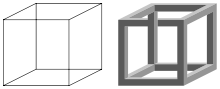
In the twentieth century, artists began to play with perspective by drawing "impossible objects". These objects included stairs that e'er ascend, or cubes where the dorsum meets the front end. Such works were popularized by the artist 1000. C. Escher and the mathematician Roger Penrose.[ citation needed ] Although referred to equally "impossible objects", such objects as the Necker Cube and the Penrose triangle can be sculpted in 3-D by using anamorphic illusion. When viewed at a certain angle, such sculptures appear equally the so-called impossible objects.
Ames rooms [edit]
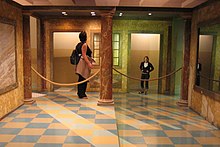
Ames room forced perspective
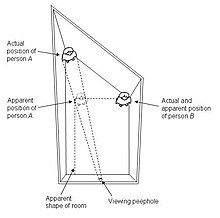
The Ames room was invented past American scientist Adelbert Ames Jr. in 1946.[12] When viewed through a peephole, the room appears to have normal perspective. Yet, all other viewpoints reveal that the room is constructed of irregular trapezoids. Similar effects had been achieved during the Renaissance through the utilise of "accelerated perspective" in stage design. These included productions past Scamozzi (1588-9), Furtenbach (1625), Sabbattini (1637) and Troili (1672).[3]
I of the virtually interesting effects of an Ames room is that the distorted perspective can brand people and objects look much bigger or smaller than they really are.[thirteen] For this reason, Ames rooms are widely used in cinema for applied special furnishings. A well-known instance is the homes in the Shire from the Lord of the Rings and The Hobbit films. Through the use of forced perspective, the character of Gandalf appeared much larger than the characters of Frodo and Bilbo, without the use of digital effects.[14]
Practical uses [edit]
Cinemascope, Panavision, Technirama, and other widescreen formats employ anamorphosis to project a wider image from a narrower film frame.[ citation needed ] The IMAX company uses fifty-fifty more extreme anamorphic transformations to project moving images from a flat motion picture frame onto the inside of a hemispheric dome, in its "Omnimax" or "IMAX Dome" process.[ citation needed ]
The technique of anamorphic project tin can be seen quite commonly on text written at a very apartment bending on roadways, such as "Motorcoach Lane" or "Children Crossing", to brand information technology easily read by drivers who otherwise would accept difficulty reading obliquely equally the vehicle approaches the text; when the vehicle is near above the text, its true abnormally elongated shape can be seen.[15] Similarly, in many sporting stadiums, specially in Rugby football in Australia, information technology is used to promote company brands which are painted onto the playing surface; from the television camera angle, the writing appear as signs standing vertically inside the field of play.[ commendation needed ]
Much writing on shop windows is in principle anamorphic, as information technology was written mirror-reversed on the inside of the window glass.
-

Comparison between the "normal" motion-picture show and the anamorphic picture on a 35 mm flick in Cinemascope format
-

Mirror anamorphosis on the lower forepart of an ambulance, then the writing appears right manner round in rear view mirrors of vehicles alee of it in traffic
-

Anamorphic writing on riot helmets. Despite being written on a curved sloping surface the onlooker sees it horizontally and undistorted.
In the work of gimmicky artists [edit]

While not as widespread in contemporary fine art, anamorphosis as a technique has been used past contemporary artists in painting, photography, printmaking, sculpture, movie and video, digital art and games, holography,[1] street art and installation. The latter two art forms are largely practised in public areas such as parks, city centres and transit stations.[16]
In 1975 a major exhibition was held focusing exclusively on anamorphic imagery: Anamorphoses: Games of Perception and Illusion in Art. The artist Jan Beutener created The Room, a major new installation specifically for the exhibit.[1]
Sculpture and installation [edit]
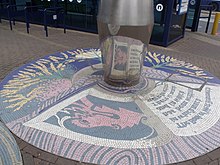
Since the mid-20th century, many artists have made use of anamorphosis in public artworks. American state art pioneer Michael Heizer's Complex One (1972-1974), a massive earth and concrete structure in the Nevada desert, creates a rectangular frame for a mastaba when viewed from a specific location.[1] Inspired by Luxor and other aboriginal monumental sites, it is part of the larger piece of work City, an enormous sculpture running a mile and a one-half long. The entire work volition not be completed until 2020.[17]
Shigeo Fukuda, a Japanese artist and designer globally renowned for his satirical posters on anti-war and environmental advancement,[18] created posters and sculptures making apply of both types of anamorphosis in the 1970s and 1980s.[19] He besides wrote multiple books on the topic of optical illusions.
Felice Varini'southward 2014 piece of work 3 Ellipses for 3 Locks in Hasselt, Belgium is an paradigm of three loops that are made up of segments painted on to over 100 buildings. Information technology is only visible from a specific vantage betoken over the city.[13]

Jean-Max Albert, Un carré pour united nations foursquare, from the specific vantage point, Place Fréhel, Paris(1988)
French artists that have created recent anamorphic installations include François Abélanet[20] and Jean-Max Albert.[21]
Markus Raetz's Kopf is a large scale public installation that reveals the course of a person'south caput in contour when viewed from a specific vantage-point. It was installed in a public park in Basel, Switzerland.[1]
While anamorphic images were not his exclusive surface area of focus, the American artist Jonathan Borofsky created installations in the 1980s using anamorphic techniques, exhibiting at institutions such as the Museum of Modern Art.[i]
Jonty Hurwitz pioneered the use of a mathematical technique to create catoptric sculptures that resolve in a cylinder.[22] In 2013 he produced a public piece of work for the Savoy Hotel's River Room.[23]
Drawing and painting [edit]
The Swedish artist Hans Hamngren produced and exhibited many examples of mirror anamorphosis in the 1960s and 1970s.
Sara Willet'due south paintings focus on anamorphic images.[21]
Belgian artist Isabelle de Borchgrave besides widely uses anamorphosis in her paintings, whereby her original drawings or paintings are stretched out and revert to a 'normal' dimension once the drawing or painting is pleated to its final course.[24]
Photography [edit]
Outset in 1967, Dutch artist Jan Dibbets based an entire series of photographic piece of work titled Perspective Corrections on the distortion of reality through perspective anamorphosis. This involved the incorporation of land fine art into his work, where areas dug out of the World formed squares from specific perspectives.[one]
Street fine art [edit]
Anamorphic effects are popular in street fine art, sometimes chosen "Slant Art" when accomplished on sidewalks. Examples are the sidewalk chalk drawings of Kurt Wenner and Julian Beever,[16] where the chalked paradigm, the pavement, and the architectural surroundings all become office of an illusion. Art of this mode can exist produced by taking a photograph of an object or setting at a sharp oblique angle, and so putting a grid over the photograph. Another elongated grid is placed on the sidewalk based on a specific perspective, and visual elements of one are transcribed into the other, one grid square at a time.
In 2016, the street creative person JR completed a massive temporary anamorphic illusion over the Louvre'due south pyramid, making the modernistic structure disappear and the original building appear equally though it was still in the 17th century.[25]
Gallery [edit]
-
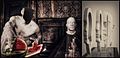
Hurwitz Singularity, anamorphic sculpture using perspective
-

Pyramidal anamorphosis
-
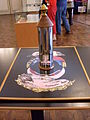
Cylindrical anamorphosis
Popular civilisation [edit]
Since the 18th century, anamorphosis has been a widespread art form in popular culture. It has been used for children's toys, album fine art, advertising, videogames and movies, among other things.
In the 1970s, albums for musicians Steeleye Span and Rick Wakeman featured anamorphic album art.[26]
The 2009 video game Batman: Arkham Aviary has a series of riddles posed by the archetype Batman antagonist The Riddler, the solution of which is based on perspective anamorphosis.[27]
In 2013, Honda released a commercial which incorporated a series of illusions based on anamorphosis.[28]
Tourists attractions employing large-scale illusory art allowing visitors to photo themselves in fantastic scenes accept opened in several Asian countries, such as the Trickeye Museum and Hong Kong 3D Museum.[29] [30]
See also [edit]
- Adelbert Ames Jr. Ames Demonstrations
- Anamorphic format, a widescreen film technique
- Anamorphic widescreen, a widescreen video encoding concept
- Arthur Mole
- Prototype warping
- Mad Fold-in
- Perspective control
- Panomorph
Artists [edit]
- Jonty Hurwitz
- Jean-Max Albert
- Julian Beever
- Peter Dazeley
- Joe Hill
- Hans Holbein the Younger
- Kelly Houle
- Patrick Hughes
- William Kentridge
- Leon Keer
- René Luckhardt
- Edgar Müller
- Matthew Ngui
- István Orosz
- Andrea Pozzo
- Eduardo Relero
- Georges Rousse
- Ed Ruscha
- Tracy Lee Stum
- Kurt Wenner
References [edit]
- ^ a b c d e f g h i j Collins, Daniel L. (1992). "Anamorphosis and the Eccentric Observer: History, Technique and Current Practice". Leonardo. 25 (2): 179–187. doi:x.2307/1575710. JSTOR 1575710. S2CID 192993644.
- ^ Sánchez-Reyes, Javier; Chacón, Jesús M. (August 1, 2016). "Anamorphic Gratis-Form Deformation". Computer Aided Geometric Design. 46: 30–42. doi:10.1016/j.cagd.2016.06.002.
- ^ a b c d e f g h i j grand l m n o p q Baltrušaitis, Jurgis; Strachan, West.J. (1977). Anamorphic fine art. New York: Harry N. Abrams. ISBN9780810906624.
- ^ "Anamorphosis". World Wide Words. November 26, 2011. Archived from the original on September i, 2012. Retrieved August 21, 2012.
- ^ Scott, Maria. "Deciphering the Gaze in Lacan'due south 'Of the Gaze as Objet Petit | The DS Project". The DS Project . Retrieved November twenty, 2018.
- ^ "Now you see me". West Highland Museum. Archived from the original on April 7, 2013. Retrieved April 15, 2013.
- ^ Tostmann, Oliver. "Tricky Artwork". Wadsworth Atheneum Museum of Art . Retrieved September 21, 2021.
- ^ Radio, Minnesota Public (January 28, 2005). "MPR: Group setting". news.minnesota.publicradio.org . Retrieved November 30, 2018.
- ^ Ades, Dawn, ed. (2000). Dalí's optical illusions: [Wadsworth Atheneum Museum of Art, January 21 - March 26, 2000: Hirshhorn Museum and Sculpture Garden, April nineteen - June eighteen, 2000 ; Scottish National Gallery of Modern Art, July 25 - October 1, 2000]. New Haven, Connecticut: Yale Univ. Press. pp. 17–18. ISBN978-0300081770.
- ^ Rex, Elliott H. (guest curator) (2010). Salvador Dalí: the late piece of work. David A. Brenneman, managing curator ; with contrib. past William Jeffet, Montse Aguer Teixidor, Hank Hine. Atlanta, Ga: Loftier Museum of Art and Yale University Press. ISBN9780300168280.
- ^ Pitxot, Antoni; Montse Aguer Teixidor; photography, Jordi Puig; translation, Steve Cedar (2007). The Dalí Theatre-Museum. Sant Lluís, Menorca: Triangle Postals. ISBN9788484782889.
- ^ "Ames Room". psychologie.tu-dresden.de. 2001. Archived from the original on April 16, 2016. Retrieved September 15, 2011.
- ^ a b "Anamorphosis fine art". Encyclopedia Britannica . Retrieved November 18, 2018.
- ^ England, Jason (March thirty, 2015). "Hobbit houses and the Moon trick the brain and eye | Cosmos". cosmosmagazine.com . Retrieved November 20, 2018.
- ^ "Section 3B.twenty Pavement Word, Symbol, and Arrow Markings". Manual on Uniform Traffic Command Devices. United States Federal Highway Administration. 2009.
- ^ a b Rogers, SA (May 8, 2010). "Perspective Puzzle: Anamorphic Art in the Toronto Subway". WebUrbanist . Retrieved November 19, 2018.
- ^ Goodyear, Dana (August 29, 2016). "A Monument to Outlast Humanity". The New Yorker . Retrieved November 20, 2018.
- ^ Heller, Steven (January nineteen, 2009). "Shigeo Fukuda, Graphic Designer of Wit and Innuendo, Dies at 76". Retrieved November 18, 2018.
- ^ "Art of Shigeo Fukada". Illusionworks. Retrieved November 18, 2018.
- ^ Adams, Henry (November 29, 2011), Is a "Garden" the World'due south Greatest New Artwork?
- ^ a b Marcolli, Mathilde. "THE NOTION OF SPACE IN MATHEMATICS THROUGH THE LENS OF MODERN Art" (PDF). www.its.caltech.edu . Retrieved Dec 18, 2018.
- ^ Christopher Jobson (January 21, 2013). "The Skewed, Anamorphic Sculptures and Engineered Illusions of Jonty Hurwitz". Jumbo.
- ^ Alice Jones (May 2, 2013). "A homage to Kaspar the friendly cat checks in at the Savoy's new eatery". The Independent.
- ^ "Isabelle de Borchgrave". isabelledeborchgrave.com.
- ^ "JR completes monumental anamorphic artwork on the louvre's drinking glass pyramid". designboom architecture & design magazine. May 28, 2016. Retrieved November 19, 2018.
- ^ "Rick Wakeman official website". rwcc.com. Archived from the original on December 20, 2009. Retrieved January 14, 2012.
- ^ "Batman FAQ". GamerShell.com. Archived from the original on January twenty, 2012. Retrieved January xiv, 2012.
- ^ "This Honda Ad Leaves Me a Little Apartment". Slate. Oct 26, 2013. Retrieved December 10, 2013.
- ^ "iii-D museums: Next big matter for Asia tourism?". CNBC. August 28, 2014.
- ^ "3-D art wows visitors | the Straits Times". June thirteen, 2014.
Bibliography [edit]
- Andersen, Kirsti (1996) "The mathematical treatment of anamorphoses from Piero della Francesca to Niceron", pp 3 to 28 in History of Mathematics, J.W. Dauben, M. Folkerts, Due east. Knobloch & H. Wussing editors, ISBN 0-12-204055-four MR1388783.
- Baltrušaitis, Jurgis (1976) "Anamorphic Fine art". Trans. W.J. Strachn. Harry N. Abrams Inc. New York. Standard Volume Number: 8109-0662-7. Library of Congress: 77-73789 ISBN 978-0810906624
- Baltrušaitis, Jurgis (1984) Anamorphoses ou Thaumaturgus opticus. Flammarion, Paris. ISBN 978-2080126047
- Behrens, R.R. (2009a). "Adelbert Ames Two" entry in Camoupedia: A Compendium of Research on Art, Architecture and Camouflage. Dysart IA: Bobolink Books, pp. 25–26. ISBN 0-9713244-6-8.
- Behrens, R.R. (2009b). "Ames Demonstrations in Perception" in E. Bruce Goldstein, ed., Encyclopedia of Perception. Sage Publications, pp. 41–44. ISBN 978-1-4129-4081-8.
- Cole, Alison: Perspective (1992) Dorling Kindersley, London. ISBN 978-1564580689
- Damisch, Hubert: L'Origine de la perspective (1987) Flammarion, Paris. ISBN 978-2080126115
- De Rosa, Agostino; D'Acunto, Giuseppe (2002) La Vertigine dello Sguardo. Tre saggi sulla rappresentazione anamorfica (The Vertigo of Sight. Three Essays on the Anamorphic Representation). Cafoscarina Publishing, Venice. ISBN 9788888613314
- De Rosa, Agostino (Ed), Jean François Nicéron (2012) Prospettiva, catottrica east magia artificiale (Jean François Nicéron. Perspective, catoptric and artificial magic), 2 Vols. with critical editions and translations of J. F. Nicéron'south La Perspective curieuse and Thaumaturgus opticus. Marsilio, Venezia. ISBN 978-8854860322
- Du Breuil, La Pere (1649) La Perspective pratique. Paris.
- Fischer, Sören (2016) "Una vista amirabile": Remarks on the Illusionary Coaction Between Real and Painted Windows in 16th Century Italy, in The Most Noble of the Senses: Anamorphosis, Trompe-L'Oeil, and Other Optical Illusions in Early Modern Art, ed. past Lilian Zirpolo, Ramsey, New Jersey, ISBN 978-0-9972446-1-8, pp. 1–28.
- Foister, Susan, Roz Ashok, Wyld Martin. Holbein's Ambassadors. National Gallery Publications, London. ISBN 978-0300073263
- Haddock, Nickolas (2013) "Medievalism and Anamorphosis: Curious Perspectives on the Middle Ages," in Medievalism Now [ permanent dead link ] , ed. E.Fifty. Risden, Karl Fugelso, and Richard Utz (special issue of The Year'south Work in Medievalism, 28).
- Houle, Kelly (2003) Portrait of Escher: Backside the Mirror. M.C. Escher'due south Legacy. Springer-Verlag, Berlin, Heidelberg, New York.
- Kircher, Athanasius (1646) Ars Magna lucis et umbrae in decem Libros digesta. Rome.
- Lanners, Edi: Illusionen. VerlagC.J.Bucher GmbH, München und Luzern, 1973. ISBN 978-0030208911
- Leemann, Fred: Anamorphosen. DuMont Buchverlag, Köln, 1975. ISBN 978-9062100163
- Leemann, Fred: Hidden Images. Harry N. Abrams, Inc. Publishers, New York, 1976. ISBN 978-0810990197
- Maignan, Emmanuel (1648) Perspectiva horaria, sive de Horographia gnomonica.... Rome.
- Mastai, Yard. L. d'Otrange (1975) Illusion in Art. Abaris Books, New York. ISBN 978-0913870037
- Niceron, Jean-Francois (1638) La Perspective curieuse ou magie artificelle des effets merveilleux. Paris.
- Niceron, Jean-Francois (1646) Thaumaturgus opticus, seu Admiranda optices per radium directum, catoptrices per radium reflectum. Paris.
- N, John (2002) The Ambassadors' Surreptitious. Hamblendon and London, London. ISBN 978-1852854478
- István, Orosz (2000) Artistic Expression of Mirror, Reflection and Perspective. Symmetry.
-
-
- – (2002) Portland Press, London.
-
- István, Orosz (2003) The Mirrors of the Chief. Escher Legacy. Springer-Verlag, Berlin, Heidelberg, New York.
- Quay, Stephen and Timothy (1991) De Artificiali Perspectiva, or Anamorphosis (film)
- Shickman, Allan: "Turning Pictures" in Shakespeare'due south England. University of Northward. Iowa, Cedar Falls Ia. Art Bulletin LIX/March 1, 1977.
- Sakane, Itsuo: A Museum of Fun (The Expanding Perceptual Globe) The Asahi Shimbun, Tokyo, 1979 (Part I.) 1984 (Part Two.)
- Schott, Gaspar (1657) Magia universalis naturae et artis. Würzburg.
- Stillwell, John (1989) Mathematics and Its History, §7.2 Anamorphosis, pp 81,2, Springer ISBN 0-387-96981-0.
- The Arcimboldo Result (1987) (exhibition catalogue - Palazzo Grassi, Velence) Gruppo Editoriale Fabbri, Bompiani, Milan.
External links [edit]
- Phillip Kent: Art of Anamorphosis
- The 'Pericentric' lens - makes anamorphic circular images from cylindrical objects Archived February four, 2009, at the Wayback Machine
- Anamorphic art at New Scientist
- Leon Keer: Anamorphose Art
Source: https://en.wikipedia.org/wiki/Anamorphosis
0 Response to "Hanging Art That Looks Like One Thing From One Angle and and Another Thing From Another Angle"
Post a Comment